

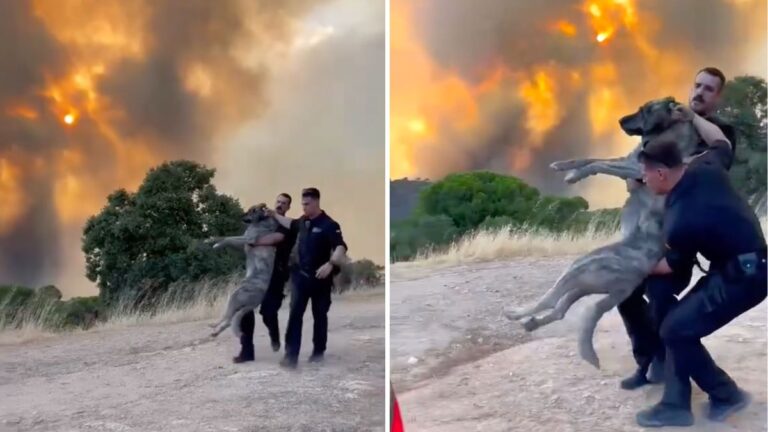
As thick smoke covered the skies above parts of the Madrid region, emergency crews worked around the clock to protect residents from rapidly spreading wildfires. The challenging conditions forced thousands of people to leave their homes while firefighters, police officers, and rescue teams coordinated large-scale evacuation efforts. Among the many moments that captured public attention was the sight of two Civil Guard officers carrying a large dog down a hillside to safety, highlighting the importance of protecting both people and their beloved pets during natural disasters.
The incident quickly became a symbol of teamwork and compassion amid one of Spain’s most difficult wildfire emergencies. While emergency responders focused on saving lives and containing the fire, they also recognized that many families could not imagine leaving behind the animals that had become an important part of their daily lives. Their actions demonstrated that emergency response often extends beyond protecting buildings and infrastructure—it also includes helping every member of a household reach safety.
The Sierra Oeste wildfires created an urgent situation that required immediate decisions. Strong winds, dry vegetation, and rising temperatures allowed the flames to spread quickly across hillsides and rural communities. Residents were advised to evacuate as soon as possible, bringing only essential belongings while following instructions from local authorities. In these stressful moments, many families faced the difficult task of transporting not only personal items but also their pets.
One family had already managed to place several dogs inside an evacuation vehicle as smoke continued to approach the area. However, one large dog remained outside because the owner could not safely lift the animal alone. Time was running short, and every passing moment increased the urgency of the evacuation. With visibility becoming more difficult and the fire continuing to advance, additional assistance became essential.
Without hesitation, two officers from Spain’s Civil Guard stepped forward to help. They quickly assessed the situation and worked together to lift the large dog before carefully carrying him downhill toward the waiting vehicle. Their coordinated effort ensured that the dog could be loaded safely while minimizing delays during the evacuation. After successfully placing the animal inside the vehicle, the officers immediately returned uphill to continue assisting other residents who were still leaving the area.
The rescue lasted only a brief moment, yet it reflected the broader mission shared by emergency responders throughout the wildfire crisis. Every evacuation required teamwork, quick communication, and the willingness to adapt to unexpected challenges. Whether helping elderly residents, guiding families through smoke-filled roads, or assisting with animals that could not easily be transported, emergency crews continuously adjusted their priorities based on the needs they encountered.
Images and videos of the rescue soon spread across news outlets and social media platforms, drawing praise from viewers around the world. Many people commented on the calm professionalism displayed by the officers despite the dangerous conditions surrounding them. Others noted that the rescue illustrated the strong emotional connection between families and their pets, especially during times of crisis when difficult choices must be made within minutes.
The Civil Guard later shared a simple but meaningful message describing their mission: “We leave no one behind, regardless of species.” Those few words resonated with audiences because they reflected an approach centered on compassion as well as public service. For many families, pets are lifelong companions that provide comfort, emotional support, and stability. Protecting them during emergencies helps reduce stress for both owners and rescue personnel.
Wildfires have become an increasingly important public safety challenge across many parts of Southern Europe. Extended periods of hot weather, low humidity, and dry forests create conditions where fires can spread rapidly once they begin. Although firefighters continue improving prevention strategies and response capabilities, extreme weather events have increased the complexity of managing large wildfire incidents.
The Madrid region experienced particularly challenging conditions as flames spread across extensive areas of land. Reports indicated that approximately 28,000 to 34,000 hectares were affected by the fires, making this one of the region’s significant wildfire events. Firefighters from multiple agencies worked continuously to slow the spread while protecting nearby communities and important infrastructure. Their efforts included creating firebreaks, monitoring changing wind patterns, and coordinating aerial firefighting operations whenever conditions allowed.
While officials reported progress in containing the most intense areas of the fire, authorities emphasized that caution remained necessary. Even after visible flames decrease, wildfire zones can continue to present hazards including hot spots, shifting winds, and reduced air quality caused by lingering smoke. Emergency management teams therefore encouraged residents to remain informed through official updates before returning to evacuated neighborhoods.
Spanish Prime Minister Pedro Sánchez also reminded the public that the emergency was not yet completely over. His message highlighted the importance of remaining vigilant while firefighters continued their work. Public cooperation plays a major role during natural disasters, as following evacuation orders and official guidance helps emergency responders operate more effectively while reducing unnecessary risks.
The rescue of the large dog represented only one story among countless examples of cooperation seen throughout the wildfire response. Across affected communities, neighbors helped each other transport belongings, volunteers supported evacuation centers, veterinarians assisted displaced animals, and emergency workers continued providing essential services despite long hours under demanding conditions. These combined efforts demonstrated how communities often come together during challenging circumstances.
Animal rescue has become an increasingly recognized part of disaster management worldwide. Many emergency organizations now include procedures specifically designed to assist pets, livestock, and other animals during floods, hurricanes, earthquakes, and wildfires. Experience has shown that people are more likely to follow evacuation orders when they know their animals can also be transported safely. This understanding has encouraged greater coordination between animal welfare groups and public safety agencies.
For pet owners, emergency preparedness can make a significant difference during disasters. Experts often recommend maintaining carriers, leashes, identification tags, vaccination records, food supplies, medications, and water in an emergency kit that can be accessed quickly if evacuation becomes necessary. Planning transportation options in advance may also help reduce stress during rapidly changing situations.
The emotional bond between people and animals is especially visible during emergencies. Many families consider their pets to be full members of the household, sharing daily routines and providing companionship throughout many years. When evacuation orders are issued, ensuring the safety of these animals becomes a priority alongside protecting children, older relatives, and other loved ones. Stories like the Madrid rescue remind audiences that this connection is widely understood by emergency professionals.
Emergency responders often face situations where physical strength alone is not enough. Successful rescues require communication, trust, experience, and the ability to remain calm under pressure. The two officers carrying the large dog demonstrated these qualities by acting quickly without allowing the urgency of the situation to compromise safety. Their teamwork enabled the family to continue evacuating together without leaving anyone behind.
Firefighters, police officers, medical personnel, and volunteers each contribute unique skills during large emergencies. While firefighters concentrate on controlling flames, law enforcement officers frequently assist with evacuations, traffic management, and public safety. Medical teams prepare to treat injuries or smoke-related health concerns, while volunteers help organize shelters and distribute essential supplies. These coordinated efforts create a comprehensive emergency response capable of addressing many different challenges simultaneously.
The wildfire also served as a reminder of the importance of investing in disaster preparedness. Governments, local authorities, and emergency agencies regularly review wildfire response plans to improve evacuation procedures, communication systems, and resource coordination. Public education campaigns encourage residents living in fire-prone regions to understand evacuation routes, prepare emergency kits, and remain aware of changing weather conditions throughout wildfire season.
Environmental experts continue studying the factors that contribute to increasingly severe wildfire seasons. Forest management, vegetation control, weather monitoring, and climate patterns all influence wildfire behavior. Ongoing research helps improve forecasting models, allowing authorities to issue warnings earlier and position emergency resources more effectively before fires reach populated areas.
Beyond statistics and operational planning, however, individual stories often leave the strongest impression on the public. The image of two officers carrying a large dog through smoky conditions resonated because it represented kindness under pressure. Rather than viewing the animal as an obstacle that might delay the evacuation, the officers recognized the importance of helping the family remain together.
Public reaction reflected widespread appreciation for the dedication shown by emergency responders. Messages of support praised not only the officers involved in the rescue but also the firefighters, medical personnel, volunteers, and community members who contributed throughout the emergency. Many observers described the rescue as a hopeful reminder that compassion remains an essential part of public service, even during demanding disaster situations.
Although wildfire recovery can take months or even years, communities often begin rebuilding with renewed determination once immediate dangers have passed. Residents return home, damaged landscapes gradually recover, and support organizations continue assisting families affected by the disaster. Alongside reconstruction efforts, stories of courage and cooperation become lasting memories that inspire future preparedness and strengthen community resilience.
The rescue of one large dog may appear to be a small moment within a much larger emergency, yet it captures an important truth about disaster response. Protecting communities means protecting the relationships that matter most to the people who live there. For one family leaving home under difficult circumstances, knowing every member of the household—including the four-legged companion who needed extra help—was safely inside the evacuation vehicle made an emotional difference that cannot easily be measured.
As wildfire response efforts continue to evolve around the world, examples of compassion such as this one remind us that effective emergency management is built not only on equipment and planning but also on humanity. The actions of the two Civil Guard officers reflected professionalism, teamwork, and empathy at a moment when every second counted. Their willingness to help ensured that one family could continue their journey to safety together, reinforcing the message that acts of kindness remain powerful even in the face of nature’s greatest challenges.