




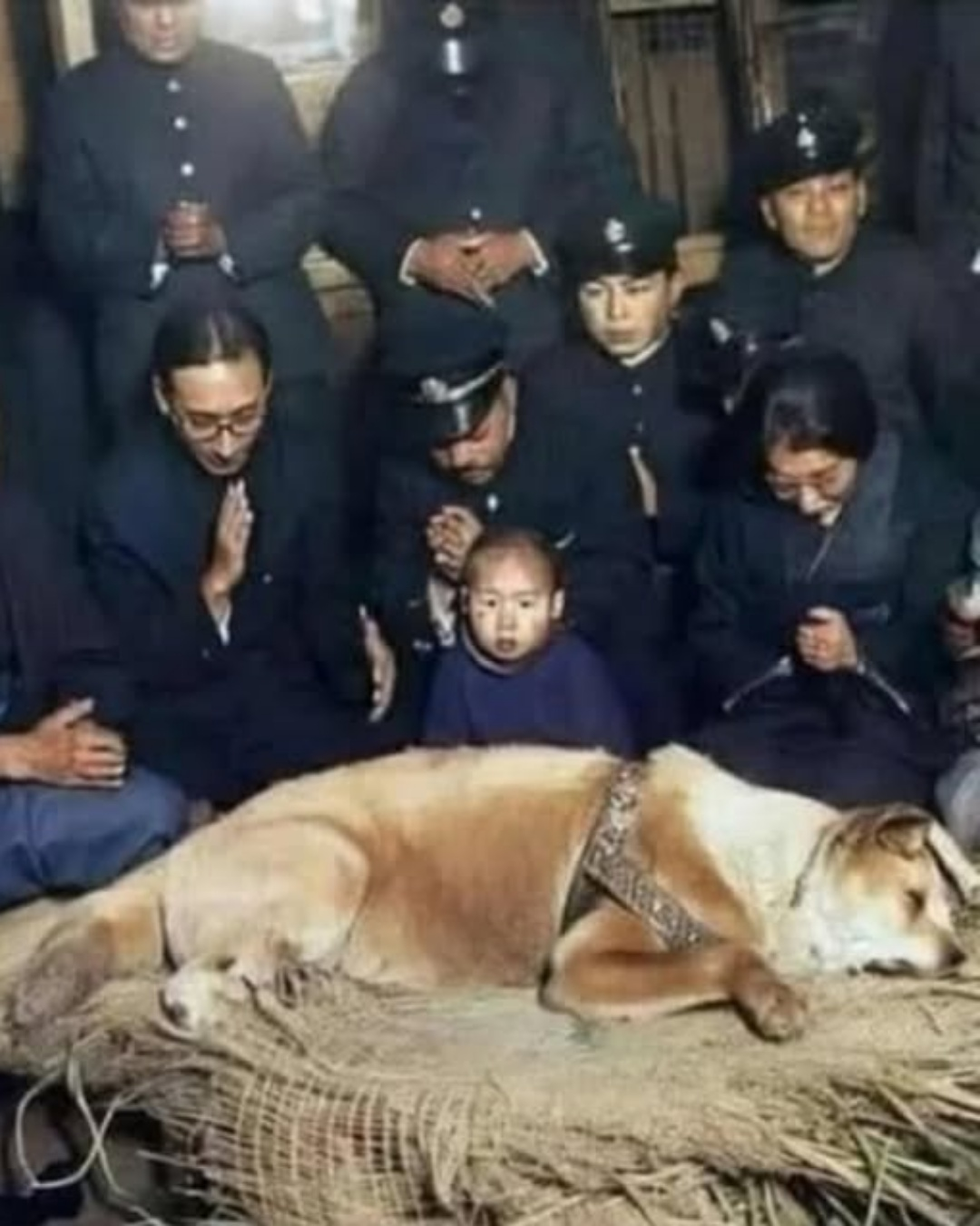
On March 8, 1935, Tokyo mourned the death of Hachikō, a dog who had spent nearly a decade waiting for his owner at Shibuya Station. Adopted by Professor Ueno in 1923, Hachikō would wait for him every day at the station after work. When the professor suddenly passed away in 1925, Hachikō, unaware of his master’s death, continued to wait. Over the years, Hachikō’s loyalty became legendary. People began bringing him food and blankets, touched by his unwavering devotion. Though he endured harsh winters and hunger, he never left his spot at the station, still hoping his master would return. Hachikō passed away in 1935 after nearly nine years of waiting. His death deeply saddened the nation. In honor of his loyalty, a bronze statue was erected at Shibuya Station. Though melted down during WWII, the statue was rebuilt and stands as a symbol of love and devotion. Today, visitors to Shibuya Station pause at the statue, reflecting on Hachikō’s story of unconditional love. His legacy continues to inspire, reminding us that true loyalty transcends time and life itself.
To truly comprehend the depth of Hachikō’s vigil, one must first understand the bond that preceded it. His relationship with Hidesaburō Ueno, a professor in the agriculture department at Tokyo Imperial University, was more than a simple dynamic between a man and his pet. It was a partnership built on a foundation of quiet companionship and unbreakable routine. Hachikō, a purebred Akita, was a breed known for its dignity and profound loyalty to family. In Professor Ueno, he found not just a master, but the center of his universe. Their daily ritual—the morning walk to Shibuya Station, the professor’s gentle pat on the head before boarding his train, and Hachikō’s unfailing return in the late afternoon to greet him—was the rhythm to which their lives were set. This was not a chore or a trick; it was an expression of a deep, unspoken love, a daily promise made and kept. The station was not merely a location, but a stage for their reunion, a place where the bond was reaffirmed each day amidst the bustling crowds of 1920s Tokyo.
When Professor Ueno suffered a fatal cerebral hemorrhage at work on May 21, 1925, he broke his part of the promise for the first and only time. For Hachikō, however, the ritual was immutable. The professor’s absence was not an ending but a disruption, an anomaly that his loyal heart believed would eventually correct itself. So he returned the next day, and the day after that, and the day after that. In the beginning, his presence was likely unremarkable, just another stray in a busy city. But as days turned into weeks, and weeks into months, the station workers and regular commuters began to notice the noble Akita who scanned the face of every passenger disembarking the afternoon train. They saw the hopeful tilt of his head, the expectant look in his eyes that slowly, over time, settled into a look of patient resolve. He was taken in by relatives of the professor, but he would consistently escape to return to Shibuya Station, to the only place that held the scent of his last happy memory.
His life during these years of waiting was a testament to his resilience. He faced the world with a quiet stoicism, weathering the sweltering humidity of Tokyo’s summers and the biting winds of its winters. He endured the cruelty of those who saw him as a nuisance and the indifference of the countless thousands who hurried past, lost in their own worlds. Yet, his story began to weave itself into the fabric of the community. Local shopkeepers, moved by his persistence, would leave out scraps of food. Commuters began to see him not as a stray, but as a permanent fixture of the station, a silent guardian of a forgotten promise. The turning point came in 1932, when one of Professor Ueno’s former students, Hirokichi Saito, an expert on the Akita breed, recognized the dog. He followed Hachikō from the station to the home of Ueno’s former gardener, Kuzaboro Kobayashi, and learned his story. Saito was so moved that he published several articles about Hachikō’s remarkable loyalty, and soon, the tale of “Chūken Hachikō” (the faithful dog Hachikō) spread across Japan.
He became a national sensation. His story resonated deeply with Japanese culture, which holds loyalty (chūgi) as one of its highest virtues, an ideal historically linked to the samurai code of bushido. Hachikō was seen as a living embodiment of this principle—a pure, unwavering spirit in a rapidly modernizing world. He became a moral exemplar, a hero whose devotion was held up for children to emulate. People traveled from all over the country to see him, to offer him treats, and to simply sit in his presence. He was no longer a lonely dog waiting for one man; he was a symbol of fidelity waiting for all of humanity to remember its better self. His quiet dignity rebuked the fleeting nature of modern life, offering a powerful, silent sermon on the virtues of patience, faith, and love.
The erection of his bronze statue in 1934, a year before his death, was an unprecedented honor. Hachikō himself was present at its unveiling, a frail and aging guest of honor at a ceremony celebrating his own legend. When he finally passed away on a street near the station in 1935, the entire nation mourned. His death made the front page of major newspapers. His body was preserved and is now on display at the National Science Museum of Japan in Ueno, Tokyo. The statue’s subsequent destruction for the war effort in 1944 could have been the end, but the story was too powerful to be forgotten. In 1948, a new statue was commissioned, sculpted by the son of the original artist, and reinstalled in its rightful place. It was a defiant act of remembrance, a signal that even in the ashes of war, the values Hachikō represented—love, loyalty, and memory—were essential to rebuilding the nation’s soul.
Today, the Hachikō statue is one of Tokyo’s most iconic landmarks and a wildly popular meeting spot. Amidst the neon glow of the Shibuya Scramble Crossing, the world’s busiest intersection, the small bronze dog offers a point of stillness and reflection. He sits, forever waiting, as millions of lives swirl around him. For tourists, he is a photo opportunity and a touching story. For locals, he is a reliable landmark in a city of constant change. But for everyone, he remains a powerful symbol. He reminds us that the greatest stories are often the simplest ones, and that the deepest connections we forge are our most important legacy. In a world that often prioritizes the new and the next, Hachikō’s ten-year vigil is a timeless testament to the power of looking back, of remembering, and of holding on to love, even when its object is gone. His wait is over, but his watch continues, a permanent part of Shibuya’s heart, silently teaching every generation that true devotion never dies.