

Safari ranger Elias had spent years on the sweeping grasslands of Kenya’s Masai Mara. He had witnessed lions stalk wildebeest under the moonlight, cheetahs explode into breathtaking bursts of speed, and hyenas cackle over scraps of bone. He was used to the raw truth of the wild—its beauty, its brutality, and its indifference to human ideas of kindness. But nothing prepared him for what he saw that morning.
A leopard had taken down a mother antelope, a swift and deadly strike that barely startled the nearby birds. It was routine, as Elias knew too well. Yet within the tall golden grass lay something unexpected: the mother’s fawn, trembling, helpless, and moments away from becoming another casualty of survival.
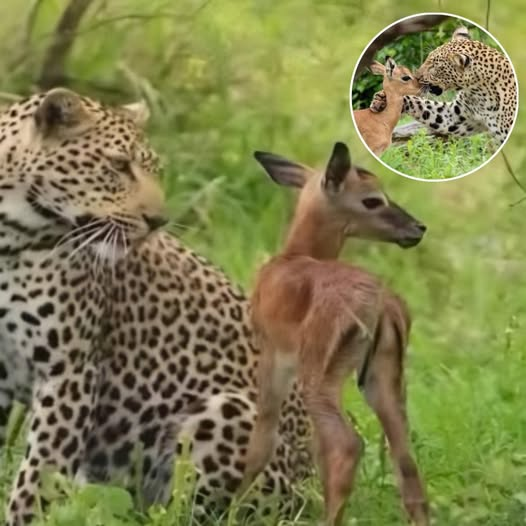
Elias raised his camera, bracing himself for the inevitable. But instead of turning on the fawn, the leopard did something extraordinary. She lay down beside it. She neither struck nor snarled. She simply watched, as if curious, as if some invisible boundary had stopped her. The baby antelope froze at first, then slowly shifted closer, as though sensing that—for reasons beyond instinct—it was safe.
The ranger thought it would end quickly. Surely hunger would prevail. Surely the rules of nature would not bend for sentiment. Yet the hours passed, and the leopard did not harm the fawn. That night, she guarded it from circling jackals, swatting them away with swift snarls and a whip of her tail.
The next morning, Elias returned. They were still together.
Over the following days, Elias watched a bond take shape—strange, fragile, but undeniable. The fawn began following the leopard as though she were its mother. When she rested in the shade, the fawn curled up against her spotted flank. When she moved through the brush, the fawn trotted behind her, its tiny legs struggling to keep up but determined not to lose sight of its unlikely protector.
Elias captured photo after photo, unable to believe what he was witnessing. Each evening, as the sun bled red into the horizon, he would leave the pair still side by side, and each morning he would return half expecting to find only the leopard. But each morning, they were still there—alive, together.
For two full weeks, this bond defied the savannah’s merciless rhythm.
Hunters became guardians. Prey became companion.
Word spread quickly among the small community of rangers and conservationists. Some dismissed it as a temporary pause in the leopard’s hunger, others wondered if she had recently lost a cub of her own. Leopards are notoriously solitary and fiercely predatory, but grief and instinct can take unusual turns. Perhaps in the tiny heartbeat of that fawn, the leopard found a reminder of something she had once lost.
Elias, however, resisted the urge to explain it away. He preferred to witness it for what it was: a brief, shining exception in a world where exceptions rarely survive. “The wild is brutal,” he would later say. “But sometimes it offers you a glimpse of mercy. And when it does, it feels almost sacred.”
On the fourteenth day, as dawn lit the savannah, a herd of antelope reappeared. The fawn lifted its head, ears twitching, recognizing the sound of its own kind. The leopard stood alert, muscles taut, eyes narrowing, as if torn between instinct and something deeper. For a moment, the ranger feared she would pounce, that the delicate miracle of the past two weeks would end in one final strike.
But she did not move.
The fawn hesitated, then bounded toward the herd. The leopard watched silently as it merged with its family, its small body disappearing among dozens of others. The moment was fleeting—two weeks of impossible companionship reduced to a single act of release. And then, without looking back, the leopard slinked away into the tall grass, returning to the life of a solitary hunter.
Elias lowered his camera, his chest tight with awe. He had witnessed hunts, deaths, births, migrations. But this—this was different. It was not about dominance or survival. It was about the possibility that even in the fiercest corners of the world, life can bend toward compassion.
In the days that followed, Elias shared the photographs with conservation groups and fellow rangers. The images spread quickly, sparking conversations across the world. Many saw in the leopard’s mercy a reflection of something deeply human. Messages poured in from people who felt comforted by the reminder that kindness exists in unexpected places.
Some compared it to the way humans sometimes foster children who are not their own, or adopt abandoned animals out of sheer love. Others pointed out that the story was not about denying the harshness of nature, but about recognizing its rare, unpredictable flashes of tenderness.
Scientists offered their theories. Maybe the leopard was not hungry at the time of the kill. Maybe her maternal instincts had overridden her predatory drive. Maybe the fawn had triggered something dormant in her memory. But no theory fully explained the daily reality Elias had witnessed: a predator choosing companionship over an easy meal, again and again, for fourteen days.
The Masai Mara has always been a place of paradox—where life and death dance in equal measure, where beauty and violence share the same horizon. But the story of the leopard and the fawn added a new chapter to its legacy, one that blurred the lines between instinct and mercy.
For Elias, it was a reminder of why he had devoted his life to this land. Not just to track animals or record behaviors, but to bear witness to the stories that remind humanity of its connection to the wild. “We come here expecting to see predators and prey,” he reflected. “But sometimes what we see is something much harder to explain. Something that makes us wonder if love, in some form, is part of the wilderness too.”
And so, the tale of the leopard and the baby antelope endures—not as a denial of the wild’s cruelty, but as proof that even in the most unforgiving places, mercy can bloom like a rare flower. It may not last. It may not repeat. But for those who saw it, it was enough to change the way they looked at the world.
Because sometimes, survival isn’t the only story the wild has to tell.