
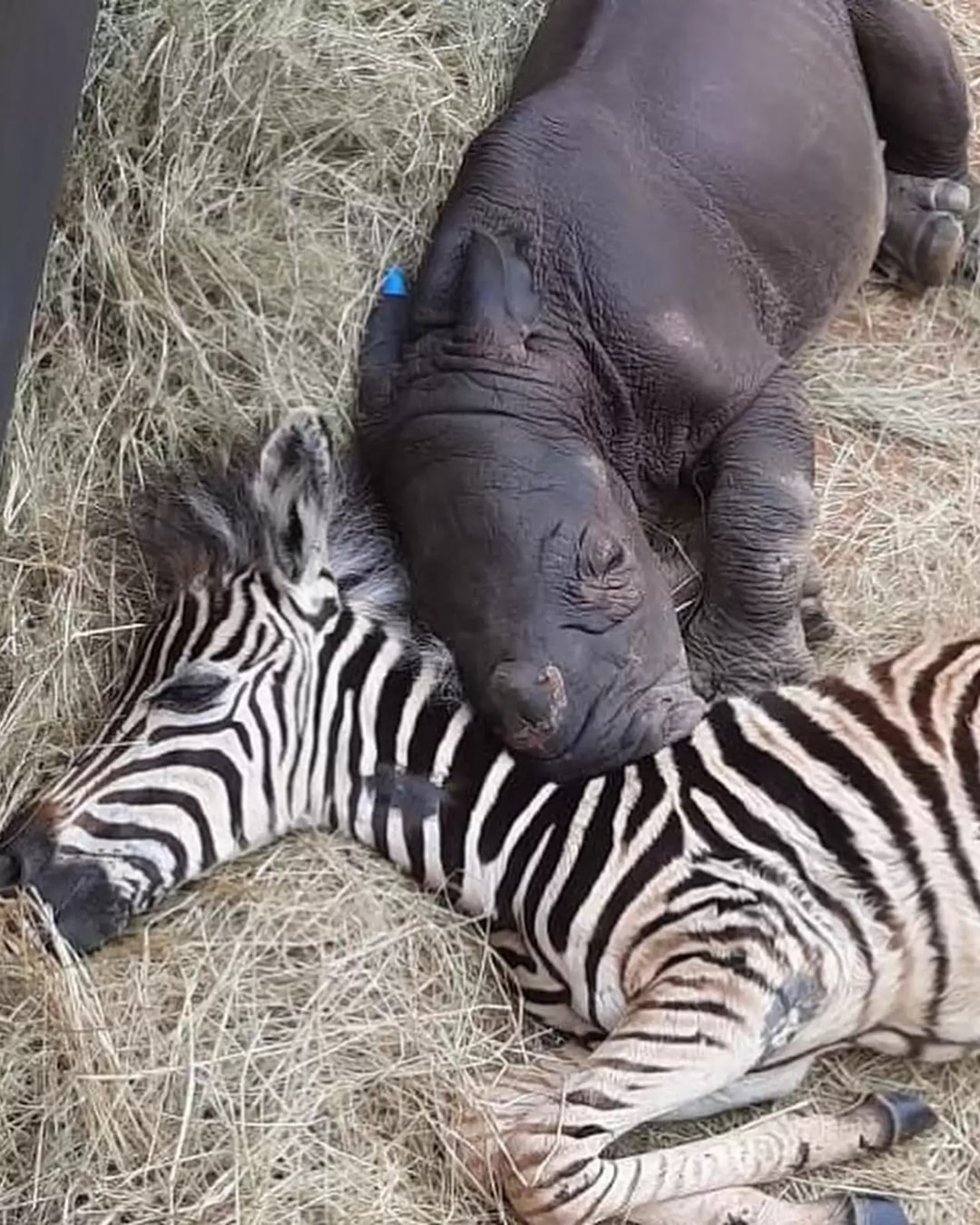
A newborn rhino calf named Daisy was found alone, just hours old, trembling and weak. Rescuers rushed her to intensive care, where she received round-the-clock treatment—but she was still missing something vital: a companion. Then came Modjadji, a tiny zebra foal rescued after storms left her barely alive. Both orphans had lost their mothers far too soon, but together they found comfort. What began as cautious curiosity grew into inseparable friendship.
Now Daisy and Modjadji eat, play, and even sleep side by side—two survivors healing through each other’s presence. One day they’ll return to the wild, but for now, they’ve chosen each other as family. Sometimes, the family you choose is the one that saves you.
The story of Daisy and Modjadji began not as a heartwarming tale, but as two separate, desperate struggles for survival against overwhelming odds. For Daisy, a white rhino calf, her first hours in the world were a terrifying introduction to vulnerability. A newborn rhino is utterly dependent on its mother for nourishment, warmth, and, most critically, protection. Without her formidable mother as a shield, a tiny, hours-old calf is an easy target for predators and susceptible to the harsh elements of the African bush. The rescue team from Care for Wild Rhino Sanctuary found her disoriented and dangerously weak, her umbilical cord still attached. The clock was ticking; every moment was critical. In the sanctuary’s intensive care unit, she was stabilized with fluids and a specialized milk formula, her tiny body swaddled in blankets to fight off the chill of shock. Yet, while the veterinary team could address her physical needs, they could not fill the profound void left by her mother’s absence—the calming presence, the nuzzles of reassurance, the very heartbeat that should have been her anchor.
Miles away, another tragedy was unfolding. A violent storm had swept through the region, leaving a trail of destruction. It was in the aftermath that Modjadji, a zebra foal no older than a week, was discovered. She was soaked, shivering, and near death, separated from her herd and mother during the chaos. Like Daisy, she was brought to the sanctuary, a tiny, striped orphan fighting for her life. Her rescuers faced a similar challenge. They could warm her, feed her, and treat her injuries, but they couldn’t replicate the complex social bonds of a zebra herd, a structure essential for a young foal’s psychological development. Two young lives, each scarred by loss, were being saved by human intervention, yet a crucial element of their healing remained elusive. They were surviving, but they were not yet thriving. The sanctuary staff knew that for traumatized young animals, companionship can be as potent as any medicine. It was a gamble, but a necessary one, to introduce these two fragile souls.
Their first meeting was a moment of quiet, cautious magic. The staff brought Modjadji into the enclosure where Daisy was resting. There was no immediate, cinematic embrace. Instead, there was a tentative curiosity, a silent negotiation between two vastly different creatures united by a shared state of orphanhood. Daisy, with her lumbering, prehistoric build, and Modjadji, with her delicate, high-strung energy, seemed an impossible pairing. Yet, they approached each other slowly, their movements filled with the uncertainty of youth. A gentle sniff, a soft nudge—these were the first words in a language they would invent together. In each other, they did not see a different species; they saw a fellow being that was small, lost, and alone. That recognition became the foundation of their bond. Within hours, the space between them vanished. Modjadji began to curl up beside Daisy’s much larger, warmer body, finding a sense of security that no blanket or heat lamp could provide. Daisy, in turn, seemed to calm in the presence of the lively little zebra, her anxiety easing with a constant companion by her side.
Their days soon fell into a comfortable rhythm, a testament to the adaptive power of friendship. Their shared enclosure became a playground of mismatched grace. Modjadji would zip and frolic around Daisy, her playful energy encouraging the more sedate rhino calf to engage. Daisy, in turn, offered a grounding, stable presence, a living mountain of comfort that Modjadji could always return to. They shared feeding times, drank from the same water trough, and explored their surroundings as a unit of two. The most touching sight for their caregivers was their sleeping arrangement. Almost every night, they would be found curled up together, a patchwork of grey hide and black-and-white stripes, perfectly content in each other’s company. This physical closeness is not merely for comfort; it is a biological necessity. For young mammals, physical contact helps regulate body temperature, reduces stress hormones like cortisol, and releases oxytocin, the “bonding hormone,” which is crucial for building social connections and fostering a sense of well-being. They were, in effect, providing each other with the therapy they both so desperately needed.
This remarkable interspecies friendship offers a profound insight into the nature of healing. While their caregivers provided the essential external support, the deepest healing was happening internally, between the two of them. They were rebuilding their shattered sense of security together, finding a new “family” in the most unexpected form. Their bond became a bridge back to normalcy, allowing them to develop the social skills and confidence they would have otherwise learned from their mothers and herds. They were not just surviving; they were learning to live again, to play, to trust, and to connect. Their story is a powerful illustration that the need for community and connection transcends species. In the wild, a rhino and a zebra would be wary neighbors, not intimate friends. But in the sanctuary of the orphanage, stripped of instinctual caution and driven by the universal need for companionship, they rewrote the rules.
The future for Daisy and Modjadji is one of hopeful complexity. The ultimate goal of the sanctuary is to return every animal to the wild, to the life they were meant to live. This means that one day, their shared journey will have to end. They will be gradually introduced to members of their own species, a crucial step in their rehabilitation. Daisy will need to learn the ways of the rhinos, and Modjadji must find her place within a zebra herd. They cannot be released together, as their long-term survival depends on integrating with their own kind. This eventual separation casts a bittersweet shadow over their idyllic friendship, but it does not diminish its importance. The bond they share now is not a permanent solution, but a life-saving chapter. It is the crucial intervention that is giving them the strength and resilience to face that future. The confidence and emotional stability they have built together will be the foundation upon which they learn to be a wild rhino and a wild zebra. The family they chose saved them, preparing them for the families they were born to rejoin. Their story is a powerful symbol of hope, a reminder that even in the face of profound loss, life finds a way forward, often through the connections we forge in our darkest hours.
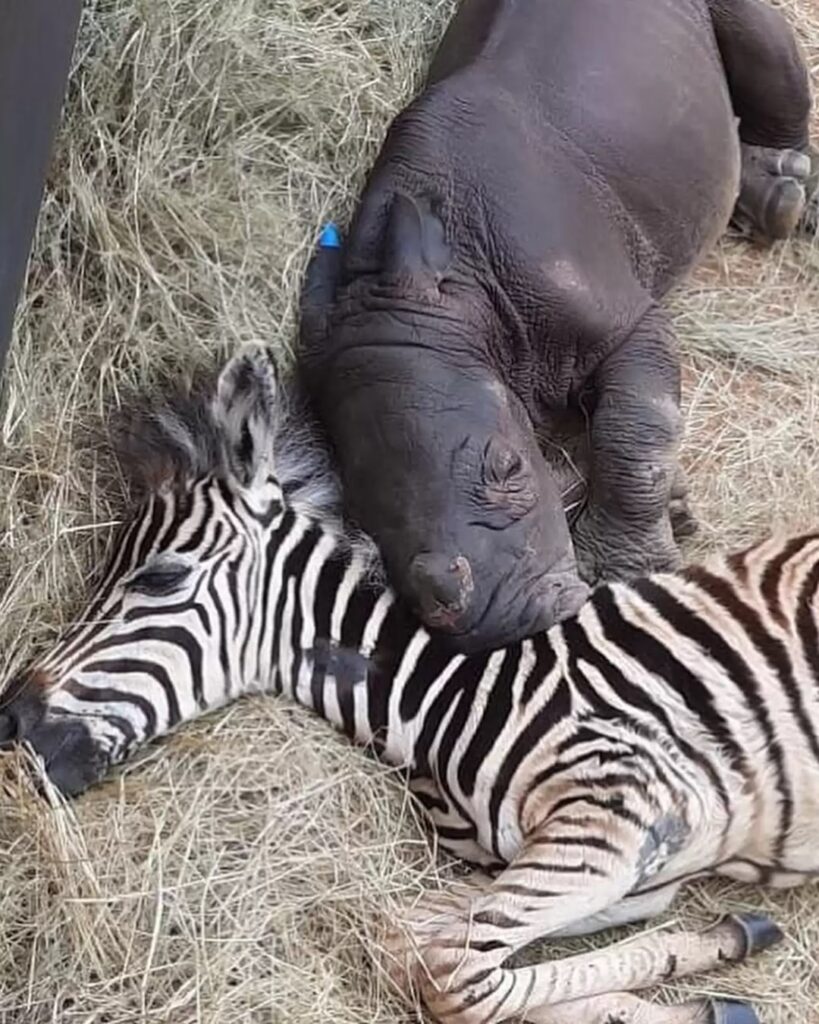
A newborn rhino calf named Daisy was found alone, just hours old, trembling and weak. Rescuers rushed her to intensive care, where she received round-the-clock treatment—but she was still missing something vital: a companion.
Then came Modjadji, a tiny zebra foal rescued after storms left her barely alive. Both orphans had lost their mothers far too soon, but together they found comfort. What began as cautious curiosity grew into inseparable friendship.
Now Daisy and Modjadji eat, play, and even sleep side by side—two survivors healing through each other’s presence. One day they’ll return to the wild, but for now, they’ve chosen each other as family.
Sometimes, the family you choose is the one that saves you.