


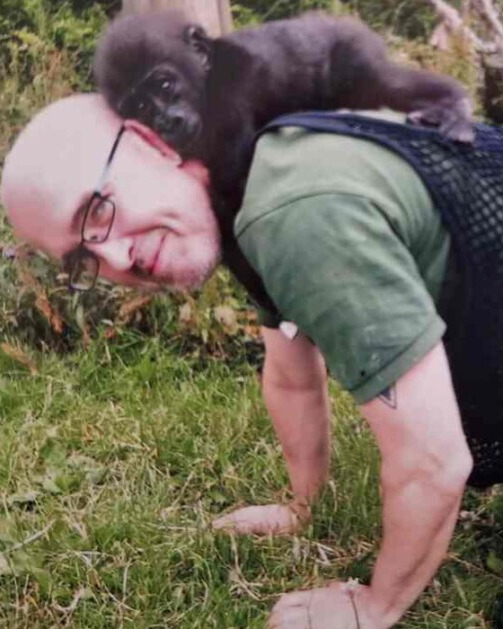
Alan Toyne never imagined that volunteering at Bristol Zoo would lead to raising baby gorillas in his own home. When Afia was born premature and rejected by her mother, Alan stepped in. He wore string vests so she could cling, ate meals with her, and even woke to her gentle taps at night—teaching her how to live like a gorilla. Later, he did the same for Hasani. Both gorillas grew strong and rejoined their troop, thanks to the months Alan and his partner lived as their “gorilla parents.”
“It was hard to say goodbye,” Alan said. “But it was worth it.”
Sometimes, saving a species starts not in the jungle—but in an ordinary living room.
The experience transformed Alan’s life in ways he had never anticipated. Every day brought new challenges, from understanding the subtle ways gorillas communicate to managing their sudden bursts of strength. Afia, despite being fragile at birth, had an unyielding spirit that kept Alan and his partner on their toes. Her tiny fingers would clutch at his clothes or hair, testing his patience while also forming the bonds that would ultimately ensure her survival. Feeding her was more than just nutrition—it was an education. Alan had to learn the delicate rhythm of gorilla meals, teaching Afia how to chew, drink, and eventually play, mimicking the instincts she would have learned from her mother.
Hasani arrived months later, and with him came a different set of challenges. He was strong but wary of humans, having been rejected in a different way. Alan had to adjust his approach, using gentle persistence rather than the constant touch that had helped Afia. Slowly, Hasani began to trust, reaching out when he felt safe, responding to Alan’s voice, and even learning simple routines like washing his hands or climbing small structures in the living room-turned-gorilla-nursery. It wasn’t long before the two baby gorillas formed a bond of their own, mirroring the social interactions of a wild troop even within the confines of a human home.
Living with gorillas reshaped the Toynes’ understanding of daily life. Every routine—cooking, cleaning, even watching television—had to be adapted to accommodate the gorillas’ presence. There were moments of chaos, such as when Afia would wrestle playfully, knocking over furniture or spilling food. There were quieter moments too, when a gorilla would curl against Alan’s chest for comfort, and he could feel a profound sense of connection. These interactions were not merely caretaking; they were a bridge between species, a dance of trust and understanding that could only be achieved through total immersion in their world.
The road to reintegration into the zoo was equally complex. Gorillas are social creatures, and learning the social hierarchy of a troop is vital for their survival. Alan and his partner worked closely with zookeepers and primate specialists, gradually introducing the young gorillas to their peers. It was a slow process. At first, Afia and Hasani were cautious, observing from a distance while other gorillas sniffed, vocalized, or displayed dominance behaviors. Alan watched countless interactions, sometimes celebrating small victories when the babies copied a peer’s gesture or shared a piece of fruit without conflict. Every step toward integration required patience, observation, and an almost scientific attention to detail.
Throughout the experience, Alan discovered that raising a gorilla is as much an emotional journey as a physical or practical one. The babies depended entirely on him, forming attachments that mirrored the maternal bonds they had been denied. Nights were punctuated by gentle taps, soft cries, and the occasional mischievous noise. The Toynes had to respond to each signal, interpreting it not through human assumptions but through careful study of gorilla behavior. Over time, this immersion developed a deep empathy and respect for these extraordinary animals, revealing the intelligence, emotional depth, and resilience that define gorillas.
Beyond the home, the story of Afia and Hasani sparked wider conversations about conservation and human responsibility. It reminded people that sometimes the survival of a species hinges not on large-scale interventions or distant forests but on the dedication and creativity of ordinary humans willing to step into an extraordinary role. Alan became an advocate for conservation, speaking at events, sharing his experience with students, and offering insights into the intimate care required to save individual lives. His story became a beacon of hope, illustrating that even in urban settings far from the wild, humans can play a pivotal role in preserving wildlife.
Alan also confronted the emotional toll of his work. Saying goodbye was perhaps the hardest aspect of raising Afia and Hasani. As they successfully rejoined their troop, Alan experienced a mixture of pride, relief, and profound sadness. The bond they had formed did not simply vanish, and moments of nostalgia often surfaced during quiet evenings. Yet, he understood that true care meant allowing the gorillas to thrive within their natural social structures, even if it meant stepping back.
The journey did not end with reintegration. Alan continued to monitor the gorillas’ progress, observing their development, social interactions, and overall health. He remained in contact with zookeepers, providing advice and support where needed. This ongoing involvement ensured that the transition from home life to the larger troop was as smooth as possible. Afia and Hasani thrived, displaying confidence, curiosity, and strength—testament to the months of dedicated care that nurtured them from fragile infants into robust young gorillas.
Their story has since inspired others to consider alternative approaches to conservation. It challenges the assumption that wildlife preservation is purely a matter of habitat protection or anti-poaching laws. Instead, it highlights the nuanced, intimate interventions that can make a tangible difference, showing that individual animals, given focused attention and human support, can be reintegrated successfully into their species’ social structures.
For Alan, the experience reshaped his worldview. The lines between human and animal, home and habitat, responsibility and love became intertwined in ways he had never imagined. He came to understand that compassion is not limited to humans; it extends across species, requiring patience, understanding, and a willingness to embrace the unknown. Raising Afia and Hasani was more than caretaking—it was a profound lesson in empathy, resilience, and the extraordinary power of connection.
Today, Afia and Hasani roam freely within their troop, strong, healthy, and fully adapted to their social environment. Alan watches from afar, content in the knowledge that his unconventional approach helped secure their future. He reflects on the months spent in his living room, recalling the small milestones, the quiet nights, and the shared meals that once defined their unique household. In those moments, he realizes that extraordinary acts of conservation can happen anywhere—even in the most ordinary spaces, as long as they are fueled by commitment and love.
In the end, Alan’s story reminds us that the boundaries of what is possible are often defined not by circumstances but by courage and compassion. Saving a species, he discovered, can begin not in the wilderness but in a living room, guided by patience, empathy, and an unwavering belief in the resilience of life. The Toynes’ home may have returned to ordinary domestic rhythms, but the echoes of gorilla footsteps, the taps of tiny hands, and the lessons of shared existence remain indelibly in their hearts.
Through their journey, the world gained more than just two healthy gorillas. It gained a testament to human kindness, to the possibility of bridging worlds, and to the belief that even the smallest acts of care can ripple outward to create lasting change. In the ordinary act of opening one’s home to the vulnerable, Alan Toyne demonstrated that heroism is not always grandiose—it can be as simple, and as powerful, as nurturing a fragile life until it is strong enough to flourish on its own.